
Norco's Historical City Directory Collections
The verified core sits at the Corona Public Library Heritage Room. Its shelf holds Riverside City & County Directories from 1889 to 1966 on microfiche, along with selected hardcover Corona volumes. Because Norco incorporated in December 1964, an edition may place a household under a county community, a Corona route, or a nearby settlement name. Scope changes by edition, so the volume's front matter controls what a search can support.
| Collection | Years | Where Held | Access |
|---|---|---|---|
| Riverside City & County Directories | 1889 to 1966 | Corona Public Library Heritage Room | Microfiche, in person |
| Selected Corona hardcover volumes | Selected years | Corona Public Library Heritage Room | In person; check scope |
| California Death Index | 1905 to 1939 | Corona Heritage Room | Microfilm or fiche |
| California Marriage Index | 1960 to 1985 | Corona Heritage Room | Microfilm or fiche |
| Corona Newspaper Archive | 1887 to 1977 | Heritage Room | Searchable in library |
| Ancestry Library Edition | Varies by database | Library computers | In-library access |
| Corona Heritage Online | Digital collection | Online | Remote images and objects |
The other holdings help turn a listing into a dated family or address trail. The death and marriage indexes can test identity and spouse links; newspapers can supply an obituary or property mention; Ancestry Library Edition adds census, military, birth, death, and directory searching from library computers. Remote access is narrower: Corona Heritage Online supplies images and local-history objects, while the newspaper archive is searchable in library.
Where the Norco Directory Shelf Lives
The nearby repository is not the Norco branch. Corona Public Library Heritage Room, 650 S. Main St., Corona, holds the verified microfiche and microfilm run; its phone is (951) 279-3593. Newspaper microfilm is available during normal library hours through the Adult Information Desk, while the dedicated Heritage Room has its own hours and phone. Hours can change, so confirm before a visit.
The Norco branch is a useful local access point for catalog and reference help, but the deep shelf work belongs in Corona. Ask staff for the exact title, year, format, geographic scope, and reader needed. A screen view or note should preserve the title page and page citation, not just a copied name.
How a Norco City Directory Entry Reads
A useful entry is more than a name. The alphabetical section may give surname, given name or initials, spouse in parentheses, occupation or employer abbreviation, home address, business address or telephone, a widow marker, and a cross-reference. When an address or reverse section exists, it may order streets and house numbers and list an occupant or business. Rural-route users and unlisted telephone subscribers can be absent, so an empty result is not a clean negative.
| Indexed name | Surname with given name or initials; compare spelling across editions. |
|---|---|
| Household link | Spouse may appear in parentheses; a widow marker can add a dated clue. |
| Occupation line | Occupation or an employer abbreviation may identify the person in that edition. |
| Address fields | Home address, business address, and telephone can appear in separate forms. |
| Cross-reference | A pointer can send the reader to another name or entry. |
| Reverse section | When included, streets and house numbers may list an occupant or business. |
Read the abbreviation key before interpreting a mark. The volume may explain forms such as rem, r, h, or bds, and the key also helps date the convention. Do not transfer a symbol from one edition to another without checking its own legend.
- Criss-cross directory
- A reverse section arranged by street and house number, showing occupants or businesses when that edition includes them.
- Householder index
- An alphabetical entry point for household heads; compare the spouse, initials, and address before treating two names as one person.
- Abbreviation key
- The volume's legend for short forms and symbols. Record it before extracting names or comparing editions.
A uniform owner or renter mark is not established for this collection. Verify any symbol in the individual volume instead of inferring tenure from a listing.
North Corona Names in Norco Directories
Geography is the biggest trap. Norco was not incorporated until December 1964, and earlier records can use North Corona, Corona routes, Orange Heights, Orchard Heights, ranch or subdivision names, or Corona itself. The community's land history reaches Rancho La Sierra and the Orange Heights tracts recorded in 1909 and 1910. A surname search that uses only Norco can therefore miss the household entirely.
Start with the terms that fit the year, then repeat the search with spelling and place-name variants. Inspect the title, publisher, year, geographic scope, abbreviation key, and any note about when the information was canvassed. Sanborn coverage for small or rural Norco was not verified. Library of Congress searches may be useful under Corona, North Corona, or Riverside County, but no Norco-specific sheet should be claimed without an authoritative match.
Trace a Norco Household Through Directory Editions
For family history or reconnection, begin with the edition nearest a known year. Capture the entry exactly, including initials, spouse, address, occupation, widow notation, and any rem, r, h, or bds notation. Photograph or cite the title page and entry page. Then move one edition backward and forward. A changed address can mark a move; a changed spouse or initial may expose a namesake; a disappearance may mean moved, died, unlisted, rural-route coverage, or a gap in the edition.
- Verify the title, publication year, geographic scope, and abbreviation key.
- Search the alphabetical section, then check the street or reverse section.
- Record every person at the address, not only the target name.
- Compare the next earlier and later editions, keeping spelling and role changes.
- Pair the address with a census schedule, deed or APN clue, and newspaper mention.
- Keep contradictions visible rather than merging similar names by guesswork.
A directory, census, and deed combination can reconnect a historical household without turning an old entry into a current-residence claim. Preserve each date and role. If an obituary, marriage index, or deed conflicts, keep both statements and test the edition canvass date, execution versus recording, address changes, and similar names.
For a related source boundary, the California Courts record-access principles explain why a court file is a distinct official source rather than a replacement for a volume.
Court access can help verify a case or probate role when relevant, but the directory remains a historical household clue.
Pair Norco City Directories With the Census
Census schedules fill gaps between editions, but release timing matters. The National Archives' public access currently reaches 1950 under the 72-year rule; 1960 is expected in 2032. Match an address, household member, and place name to the nearest released schedule. Enumeration-district maps can help when a street name or community label differs.
The National Archives census research page is the access point for the federal release framework.
The release boundary does not make every Norco household appear in every edition. Compare ages, spouse names, children, address, and county context, then mark a gap when the record is not there. A match with only one shared surname is a lead, not a conclusion.
Norco Newspapers Beside Directory Years
The Heritage Room's newspaper shelf adds a second timeline. Its microfilm runs reach beyond the directory years and can explain a move, a death, a ranch name, a civic event, or a property change. Access is in person, and the exact title and issue date should be recorded with each clipping or screen view.
- South Riverside Bee: June 1887 to June 1896.
- Corona Courier: January 1900 to April 1938.
- Corona Daily Independent: August 1906 to April 1983.
- Corona-Norco Independent: May 1983 to December 19, 2003.
- Selected Press-Enterprise: 1979 to 1990, 2000, and 2007 to 2009.
The Corona Newspaper Archive covers 1887 to 1977 and is searchable in library. Search a quoted full name, surname plus street, spouse, subdivision, school, church, obituary or death notice, property transfer, building permit, or society item. OCR can misread names and street terms, so check the page image and preserve the issue date. A newspaper supplies dated context, not sole proof of identity.
Norco City Directory Images and Local History
Corona Heritage Online offers remote residences, maps and blueprints, artifacts, and CNUSD yearbooks. These items add place context to an address or a classmate trail, but an image cannot establish current occupancy. Cite the exact item, collection, and date when visible.
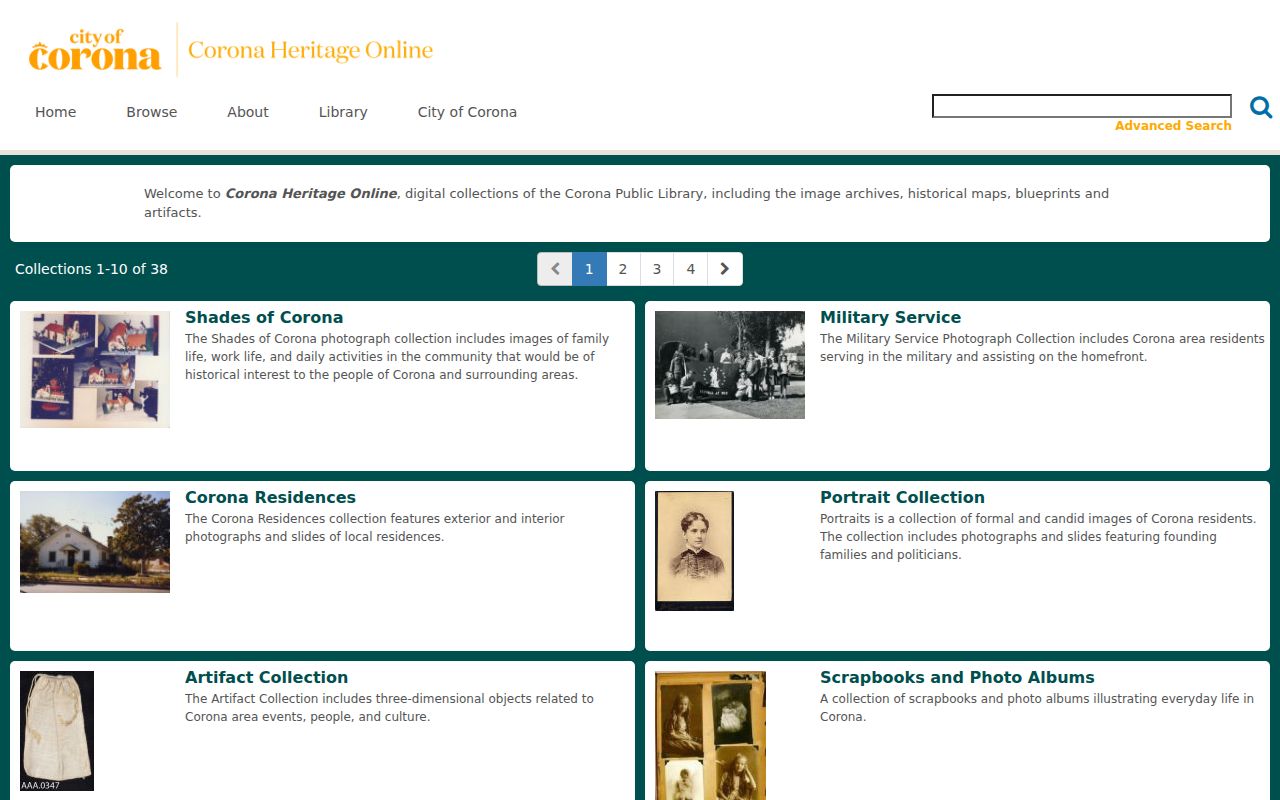
A residence photograph, blueprint, or yearbook can help test a name, building, school year, or development era. It should remain paired with the volume citation and any corroborating census, deed, or newspaper record.
A compact chronology keeps the sources in their proper order:
- 1887 to 1896: South Riverside Bee covers the pre-Norco regional press.
- 1889 to 1966: Riverside City & County Directories sit on Heritage Room microfiche.
- 1909 to 1910: Orange Heights tract maps and parent-parcel records anchor land history.
- December 1964: Norco incorporation begins the municipal record era.
- 1975 onward: ACR's searchable path covers modern official-record research, while earlier deeds need Gateway Riverside.
From a Norco Directory to County Records
Once a historical listing gives a house number or legal clue, bridge it carefully. Riverside County ACR's official-record index uses Name Search, Document Number, Document Type, Map Type and Book/Page, and Advanced Search. The web and public-office path reaches 1975; 1974 and earlier must be searched at Gateway Riverside. The result identifies parties and land instruments, not present occupancy.
Riverside County's recording services explain the official index and office path.
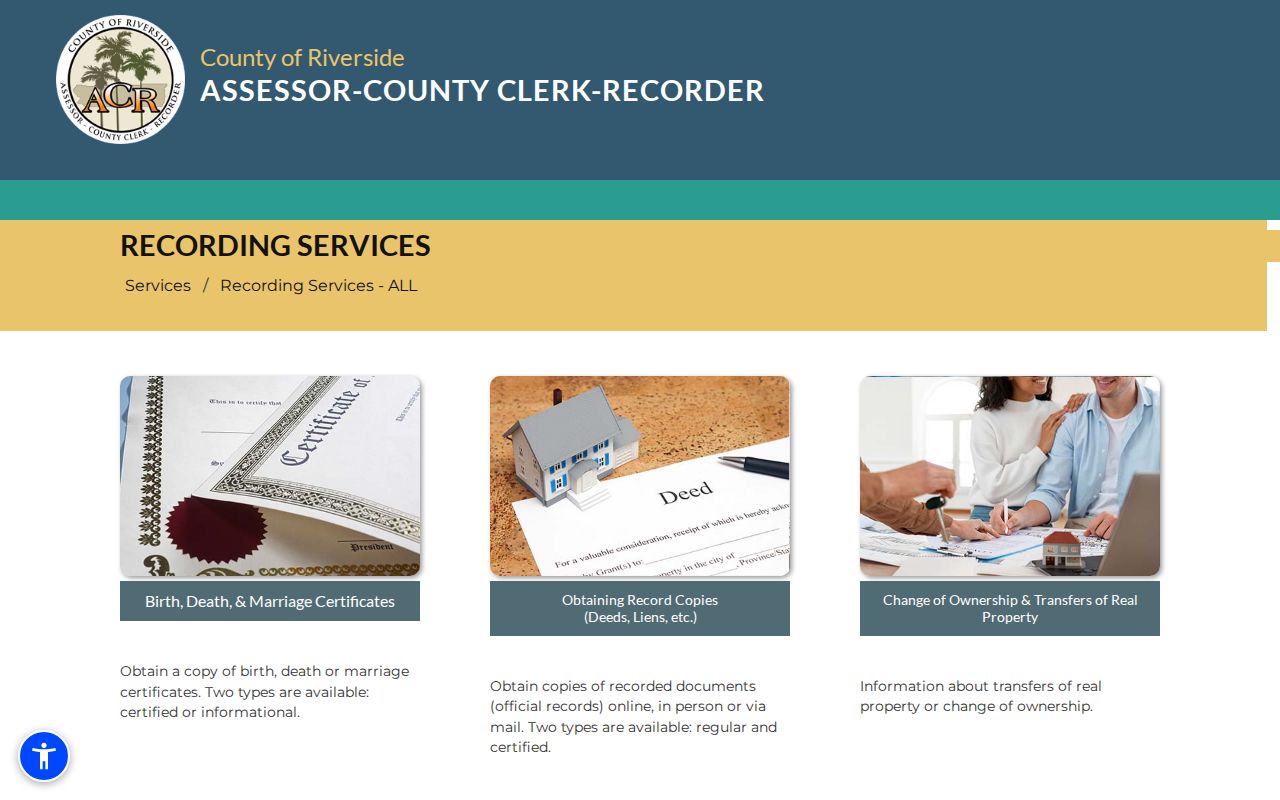
A regular or certified copy can be ordered online, in person, by mail, or through a drop box. The documented schedule is $8 for the first page, $1 for each additional page, and $2 for certification per document; online cards add 2.15 percent. Online processing averages 48 hours and mailed output follows; in-person copies are usually same day unless older or research-heavy. A mail request without a document number should include title or type, full party names, estimated recording date, and helpful APN. For pre-1976 records, staff search by mail is limited to two years after the estimated recording year.
The official copy instructions set out the order channels and explain how a record becomes a regular or certified copy.
Use two matching attributes before naming a person in a historical household: address plus spouse, middle initial, date, or another independent clue. A deed can show a grantor or grantee, not necessarily a resident. When a directory address needs a present parcel check, the Norco Street Directory route follows the address chain; when one name needs corroboration, Norco Resident Lookup adds the relevant official-record boundaries.